GEO gets your brand named and cited in ChatGPT, Gemini, Perplexity and Google AI answers. How engines pick brands, how GEO relates to SEO and how to measure it.
What GEO means
GEO stands for generative engine optimization. When someone asks an AI assistant which CRM to buy or which clinic to visit, the answer names a few brands and links a few pages. GEO is the work of making your brand one of those names and your pages among those links, together with the measurement that shows whether the work is paying off.
The answers appear on many surfaces: assistants such as ChatGPT, Gemini and Perplexity, AI Overviews and AI Mode in Google Search, Bing Copilot, and Naver AI Brief and Naver AI Tab in Korea. AEO (answer engine optimization), AI SEO and LLM optimization name the same work.
How AI engines choose what to say
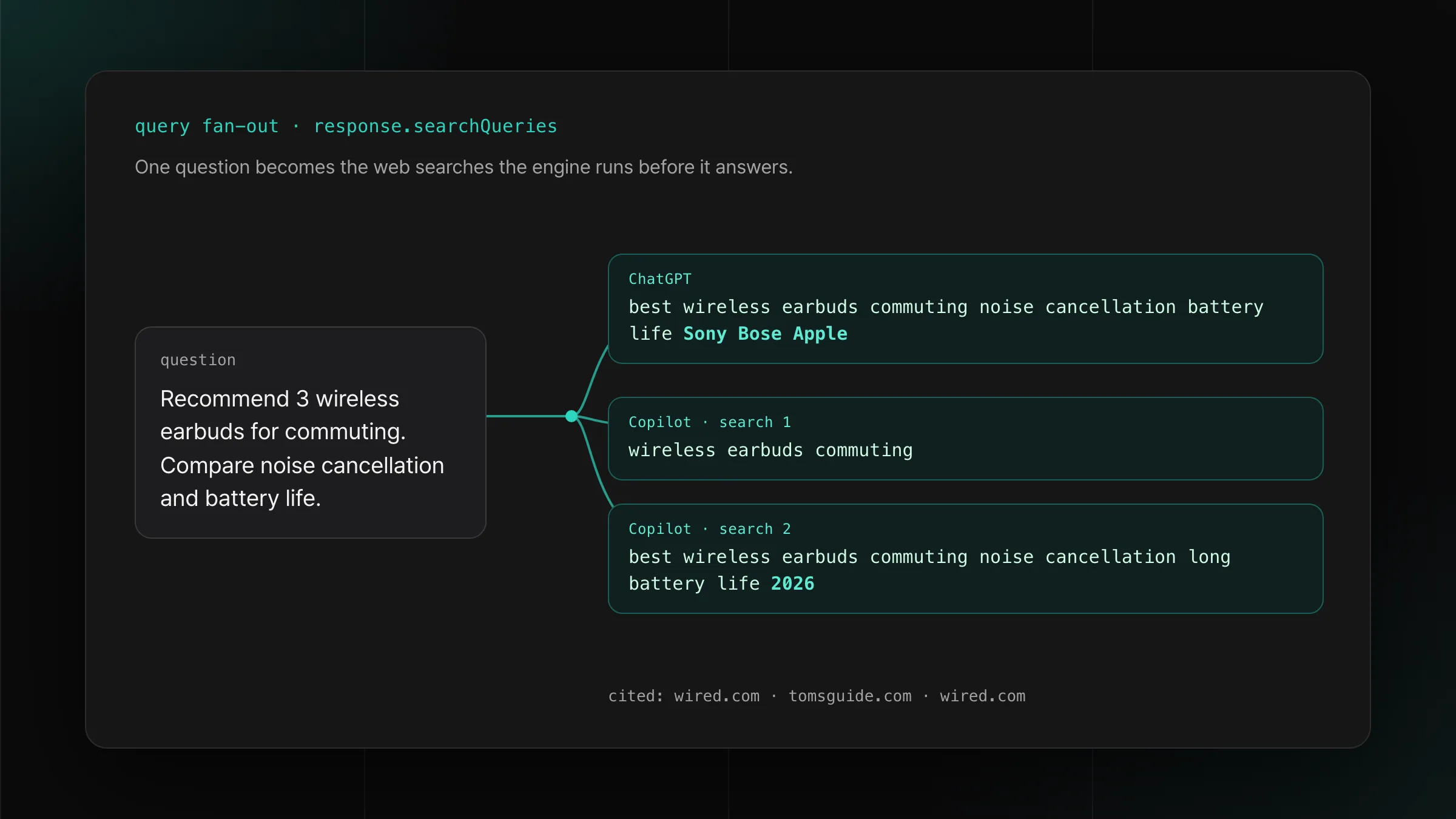
An AI engine with web search answers in three steps. It turns the question into one or more searches, reads the pages those searches return, and writes the answer from them, naming the brands and citing the pages it relied on. Three things shape the result:
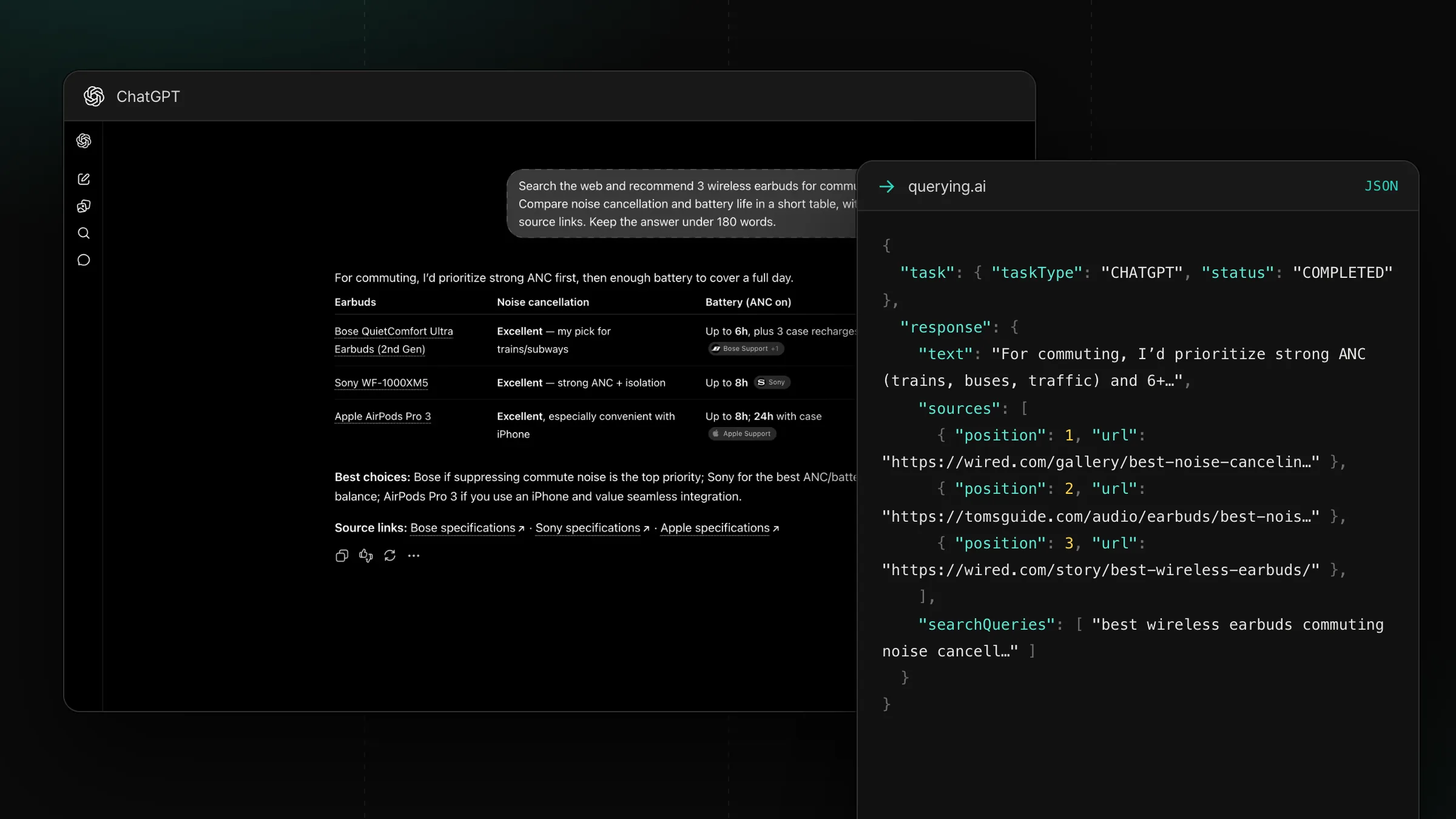
- The searches it runs. Asked “Best coffee shops near me for working on a laptop” from SoHo, New York, ChatGPT searched for “best coffee shops for laptop work near me wifi outlets”. A ChatGPT task returns these searches in
searchQueries, so you see the exact searches your pages have to win. - The pages it reads. The same answer cited a guide titled “Best Coffee Shops to Work in New York (2026) | 103 Cafes with WiFi”. The lists, reviews and comparisons an engine finds for a question become the evidence for its answer.
- The market and the place. Engines answer in the language and context of the country the question comes from, and local questions from the neighborhood it comes from.
An engine's answer follows the web it reads. Brands that appear on the pages engines find for a question, with clear facts to quote, are the brands the answers name most often.
GEO and SEO
| Aspect | SEO | GEO |
|---|---|---|
| Where buyers see you | A ranked list of links on a results page | Inside the answer an AI engine writes |
| Aim | Rank a page high for a query | Get the brand named and the page cited in the answer |
| Measure | Rankings, impressions and clicks per query | Mention rate, citation rate and share of voice over many answers |
| What moves it | Your pages, the links to them and their technical health | Your pages and the pages engines read about your category: reviews, lists, comparisons and forums |
The two overlap. AI engines with web search start from search results, so pages that rank well are often the pages engines read. The unit differs: SEO wins a place in a list of links, GEO wins a sentence in an answer, and that sentence often comes from someone else's page.
What AI answers look like today
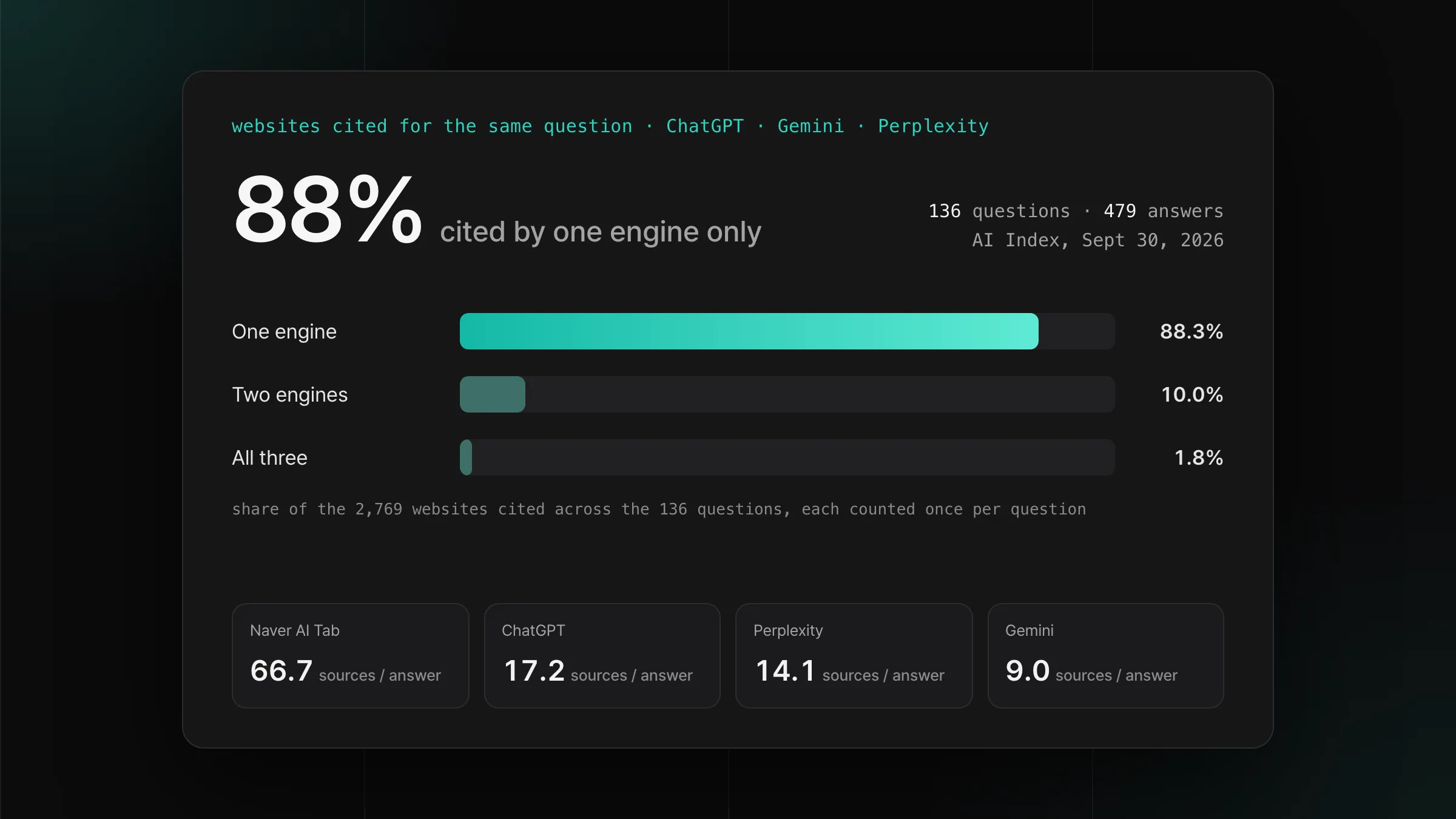
In the September 2026 AI Index, we asked ChatGPT, Gemini, Perplexity and Naver AI Tab 136 buying questions in Korea and the US:
- 82% of 479 answers named at least one brand. When people ask an assistant what to buy, the answer is a shortlist of brands.
- Engines differ. In Korea, ChatGPT named a brand in 61% of answers and Naver AI Tab in 96%. In Korean skincare, each of the four engines named a different brand most often.
- Place changes the answer. Asked for an orthopedic clinic near three Seoul stations, ChatGPT recommended clinics 45 m to 1.1 km from each station, as the local GEO study shows.
How to measure GEO
The same question gets a different answer from one run to the next, so one answer is an anecdote. GEO is measured over a fixed set of questions, asked on every engine your buyers use, from their market, on a schedule:
- Mention rate: the share of answers that name your brand.
- Citation rate: the share of answers that cite a page on your domains.
- Share of voice: your mentions out of all tracked brands' mentions.
- Competitor-only answers: answers that name a competitor and leave your brand out, the gaps to work on first.
Rates need enough answers to hold: 30 scored answers is the floor for a readable rate, as the sample size guide explains. The tracking guide walks through the setup step by step, and a monitor runs it on a schedule and keeps the answer behind every number.
How to work on GEO
- Find the questions. Start from what buyers ask before they know your brand. Prompt Research ranks the questions people ask AI assistants about a topic by monthly search demand in Korea or the US.
- Read the answers and their sources. For each question and engine, note the brands the answer names and the pages it cites.
- Work on the cited pages. Improve your own pages that engines read, and earn mentions on the reviews, lists and comparisons they cite for your category.
- Make pages easy to quote. Put the facts an answer needs near the top in plain sentences: what the product does, for whom, prices, locations and comparisons, under clear headings with dates.
- Measure again. Compare the same questions and engines before and after each change.
Frequently asked questions
What does GEO stand for?
GEO stands for generative engine optimization: the work of getting a brand named and its pages cited in the answers generative AI engines write, such as ChatGPT, Gemini, Perplexity and Google AI Overviews.
How do GEO, AEO and AI SEO relate?
They name the same work. AEO (answer engine optimization) stresses the engines that answer, AI SEO stresses the search practice it grew from, and GEO stresses the generative engines that write the answer. All three aim at being named and cited in AI answers.
How do I check whether ChatGPT mentions my brand?
Ask ChatGPT the questions your buyers ask, with your brand name left out, many times and from your market, and count the answers that name you. A monitor does this on a schedule across ChatGPT and the other engines and reports the mention rate per engine and per question.
Which AI engines matter for GEO?
The ones your buyers use. For most markets that means ChatGPT, Gemini, Perplexity and Google AI Overviews, with Google AI Mode and Bing Copilot for search-led buyers and Naver AI Brief and Naver AI Tab in Korea.