Measure how often ChatGPT, Gemini, Perplexity and Google AI name and cite your brand: the questions to ask, the engines and markets, the metrics and the API calls.
What AI visibility measures
Ask ChatGPT for the best CRM for a small team and the answer names a few brands and cites a few pages. AI visibility is how often your brand is among them. It is measured over many answers, because the same question gets a different answer from one run to the next.
| Metric | What it counts | What it tells you |
|---|---|---|
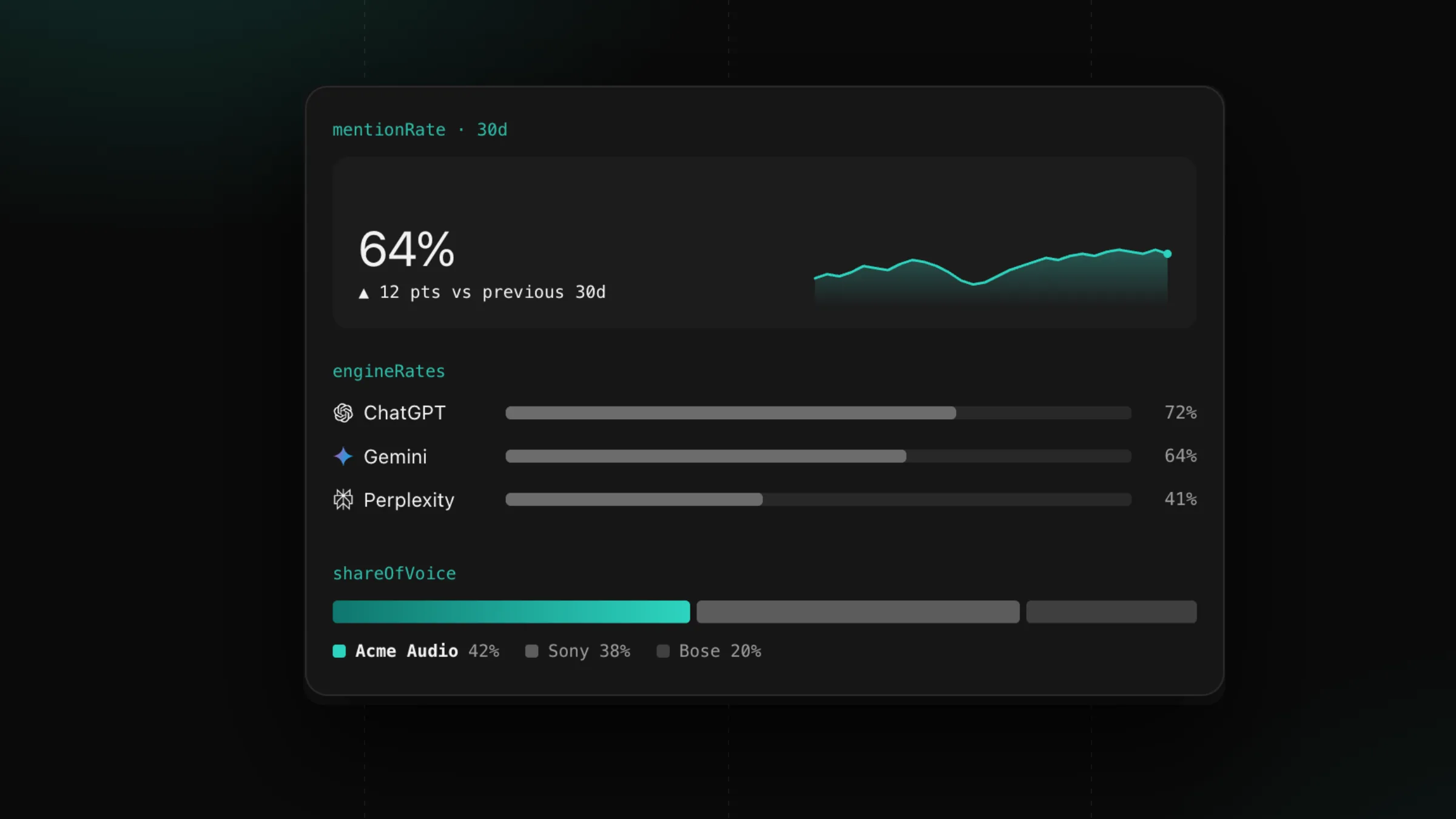
| Mention rate | Answers that name your brand, out of all answers scored | How often buyers hear your name |
| Citation rate | Answers that cite a page on your domains, out of all answers scored | How often the engine uses your site as evidence |
| Position | Where in the answer your brand first appears | How prominent the mention is |
| Share of voice | Your mentions out of all tracked brands' mentions | Your share of the conversation against competitors |
| Competitor-only answers | Answers that name a competitor and leave your brand out | The gaps to work on first |
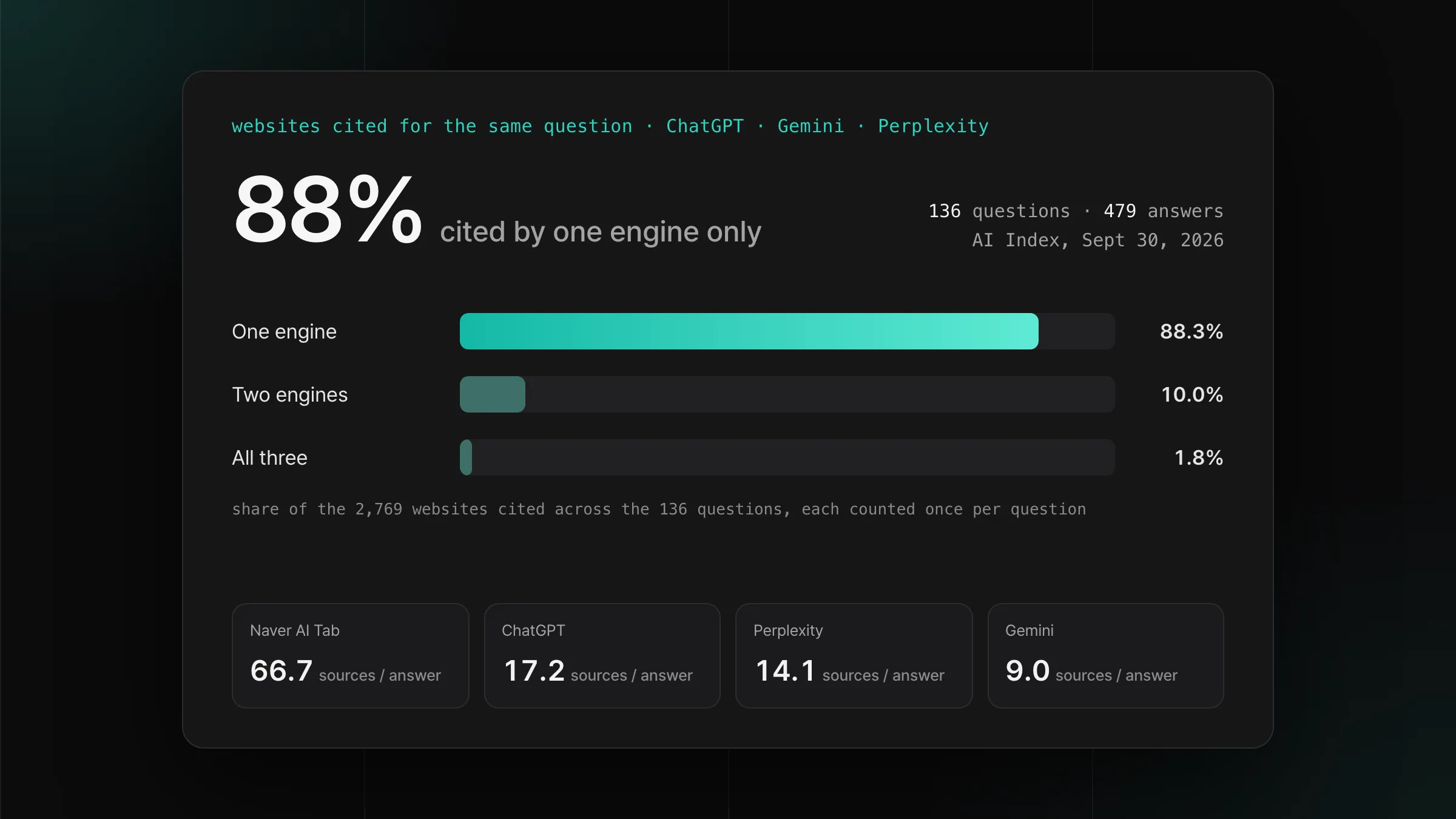
Rates matter because AI answers are full of brands. In the September 2026 AI Index, 82% of 479 answers to buying questions named at least one brand, and the engines disagreed on which ones.
Step 1. Choose the questions your buyers ask
A visibility number is only as good as the questions behind it. Track what a buyer asks before they know your brand: recommendations, comparisons and the problems your product solves. Leave your brand name out of the prompts, because a prompt that names your brand returns your brand by request and its rate stays near 100%.
Start from demand. Prompt Research turns one topic into up to 50 questions people ask AI assistants, ranked by monthly search demand in Korea or the US, and returns monitorSet, the prompts to track first. Group the prompts by sub-field and buying stage so each group reads as its own result.
- 10 to 30 prompts per market is a practical start. More prompts make every rate firmer.
- Write prompts the way people type them into an assistant, in the market's language.
- Keep one prompt set per market: Korean prompts for Korea, English for the US.
Step 2. Pick the engines and markets
Each engine is its own channel. ChatGPT, Gemini, Perplexity, Bing Copilot, Google AI Overviews and Google AI Mode answer the same question with different brands and different sources. In Korea, Naver AI Brief and Naver AI Tab sit inside the country's largest search engine. Track the engines your buyers use.
Answers also change with the country and the place. Set the country of the market you sell in. For clinics, restaurants and stores, ask from the place too: located tasks on ChatGPT, Gemini and the Google surfaces answer for a station, a district or a street address, as the local GEO study shows.
Step 3. Collect the answers
Each answer is one task. Submit the prompt, the engine and the country:
curl -X POST https://api.querying.ai/v1/async/task \
  -H "Authorization: Bearer $QUERYING_API_KEY" \
  -H "Content-Type: application/json" \
  -d '{
    "taskType": "CHATGPT",
    "payload": {
      "prompt": "What is the best CRM for a 10-person sales team?",
      "country": "US"
    }
  }'
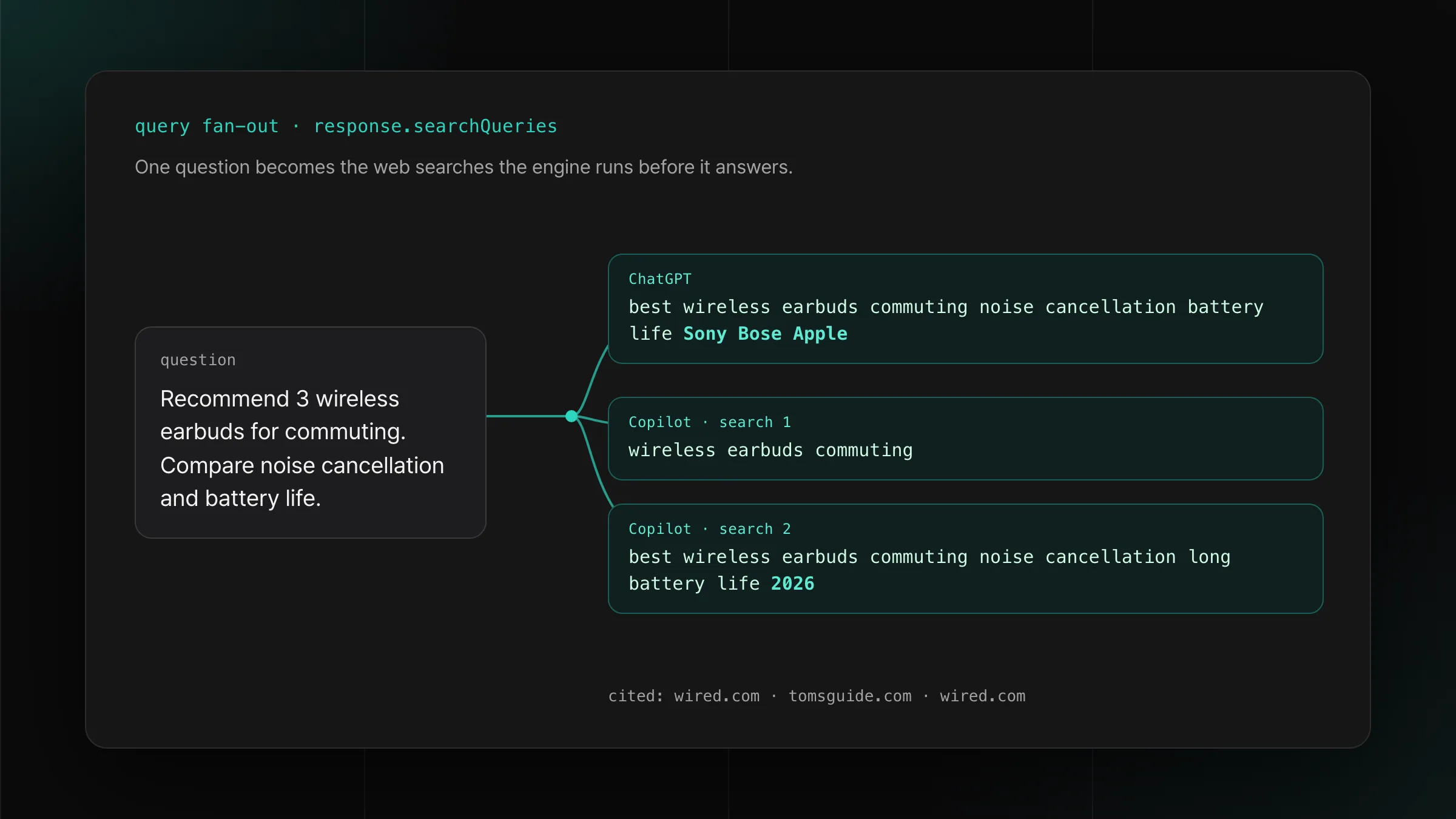
The completed task returns the answer in text and markdown, the pages it cites in sources and the searches ChatGPT ran in searchQueries. Poll GET /v1/async/task/{id} or set webhook.url to receive it. To send a whole prompt set at once, POST /v1/async/task/batch takes up to 500 tasks.
Step 4. Score every answer the same way
Apply the same rules to every answer:
- Mentioned: the answer names your brand under any of its names. List every alias, including short forms and other scripts, such as
Round Laband라운드랩. - Cited: one of the answer's source URLs sits on one of your domains.
- Position: where the first mention appears in the answer text.
- Competitors: the other tracked brands the answer names.
A monitor does all of this. It sends every prompt to every engine on a schedule, scores each answer once and keeps the answer behind every number. Create one with your prompts, aliases, domains, competitors, country and schedule:
curl -X POST https://api.querying.ai/v1/monitors \
  -H "Authorization: Bearer $QUERYING_API_KEY" \
  -H "Content-Type: application/json" \
  -d '{
    "name": "CRM, US",
    "engines": ["CHATGPT", "GEMINI", "PERPLEXITY"],
    "prompts": [
      "best CRM for a 10-person sales team",
      "easiest CRM for a small business"
    ],
    "aliases": ["Acme", "Acme CRM"],
    "domains": ["acme.com"],
    "competitors": [{ "name": "Globex" }, { "name": "Initech" }],
    "country": "US",
    "intervalHours": 24,
    "alertBelowPct": 30
  }'
Step 5. Run on a schedule and read the trend
Run the same set daily or weekly and compare equal periods. A monitor reports mention and citation rates for the window and for the window before it, per engine and per prompt, and reports the change when the two periods are comparable. It flags any window with fewer than 30 scored answers.
A run costs the number of prompts times each engine's credits. Twelve prompts on ChatGPT (2 credits) and Gemini (1 credit) cost 36 credits a run, about 1,080 credits a month on a daily schedule. Set alertBelowPct and the monitor emails you when the mention rate falls below it.
Step 6. Turn the results into work
- Open the answers behind a change. When a rate moves, read what the engines said and which brands took the place.
- Find the sources that win. The monitor lists the domains and pages the answers cite most for your prompts. Those pages are where the engines read about your category: improve your own, publish where they cite, and earn mentions on the pages they trust.
- Work through the competitor-only answers. Each one is a prompt and an engine where a competitor appears and your brand is absent: the most direct list of gaps.
- Measure again after you publish. Compare the period after a change with the period before it, on the same prompts and engines.
Frequently asked questions
How many prompts do I need to track AI visibility?
Start with 10 to 30 prompts per market. Rates firm up with the number of answers: 30 scored answers is the floor for a readable rate, and comparing two periods takes a few hundred. The sample size guide has the numbers.
How often should the prompts run?
Weekly runs show the trend for most brands. Daily runs suit launches, campaigns and fast-moving categories. Every run costs the number of prompts times each engine's credits.
What is the difference between a mention and a citation?
A mention is your brand's name in the answer text. A citation is a link to one of your pages among the answer's sources. An answer can name your brand while citing a review site, and cite your page while recommending another brand, so track both.
Which engines should I track?
The ones your buyers use. For most markets that means ChatGPT, Gemini, Perplexity and Google AI Overviews, with Google AI Mode and Bing Copilot for search-led buyers and Naver AI Brief and Naver AI Tab in Korea.